














Post-Traumatic Stress Disorder (PTSD) can look nothing like the fear and sadness most people expect, especially in men, who are more likely to show it through anger, silence, or heavy drinking.
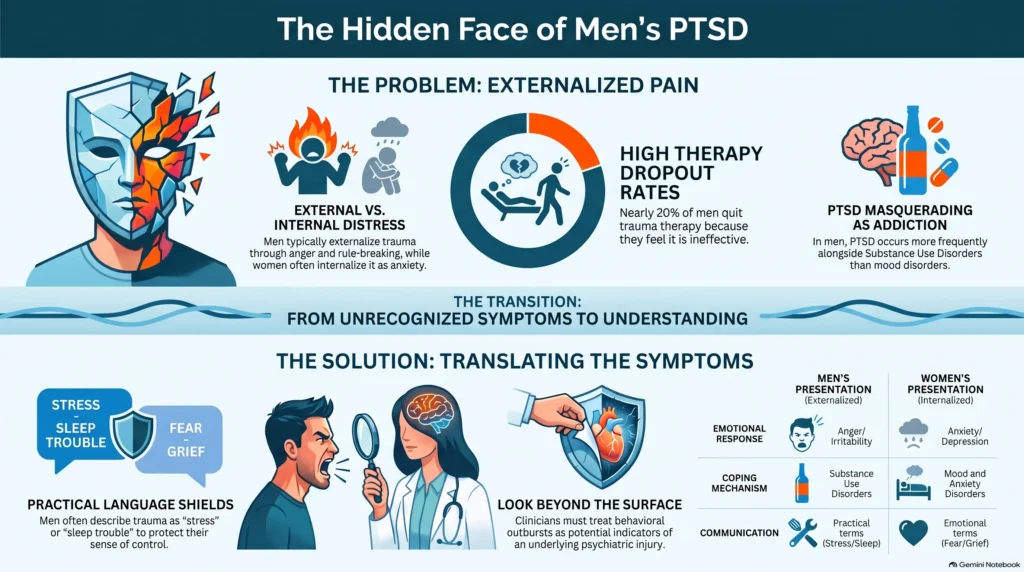
Men who seek care for PTSD are often let down: nearly one in five men who quit trauma therapy call it ineffective, and more than half say they never felt connected to their therapist [1].
David used to fall asleep the moment his head hit the pillow. Since a serious car accident last year, he snaps at his kids over small things, drinks more than he used to, and cannot explain why sleep will not come anymore.
His symptoms are PTSD. They just do not look like the version most people picture.
PTSD: Same Diagnosis, Different Presentation
The National Institute of Mental Health defines PTSD as a condition that can develop after exposure to a shocking, scary, or dangerous event, with symptoms that persist long enough to interfere with work, relationships, or daily life [2].
The diagnostic picture includes intrusive memories, avoidance, negative shifts in mood and thinking, and heightened arousal, such as being easily startled or constantly on edge.
Both men and women develop these four symptom clusters; they diverge in what carries the most weight and what gets noticed.
Women with PTSD experience comorbid anxiety and mood disorders more often, while PTSD in men occurs more frequently alongside a Substance Use Disorder (SUD) [3].
That difference alone changes how clinicians usually encounter PTSD in men — a man walking in with a drinking problem, an anger problem, or a marriage that is falling apart.
What Are the Signs of PTSD in Men?
Common PTSD signs in men include:
- Irritability and outbursts that seem disproportionate to the trigger
- Drinking or drug use to quiet intrusive thoughts
- Restlessness or a constant sense of danger
- Pulling away from friends and family
- Physical complaints without clear medical cause (e.g. headaches or chest tightness)
Because these signs read as behavioral or physical rather than psychiatric, they are frequently treated as separate problems instead of a single underlying injury.
Why PTSD Often Goes Unrecognized in Men
Masculine norms around self-reliance and emotional control play a direct role in whether a man seeks care at all, and in whether he stays once he gets there.
A recent narrative review found that men frequently disengage from therapy because they feel no connection to their therapist or doubt that talking will change anything — patterns rooted in the belief that a man should solve his own problems [1].
Why Do Men Underreport Trauma Symptoms?
Many men describe their distress in practical terms, such as stress, sleep trouble, or a short temper, rather than naming it as trauma.
Admitting fear or grief can feel like admitting weakness, so the vocabulary a man reaches for tends to protect his sense of control rather than describe what happened to him.
A clinician who is not listening for this translation risks treating the surface complaint and missing the injury underneath it.
The Weight of Untreated Trauma
Complex trauma (C-PTSD), repeated or prolonged trauma that shapes a person’s sense of self and ability to regulate emotion, does not differ much between men and women in how often it occurs [4]. What differs is how it is carried.
Research on C-PTSD has found that women tend to internalize the pain that follows sustained trauma, while men tend to externalize it through anger, rule-breaking, or substance use [4].
Externalized pain is easy to misread. A man who is drinking more, picking fights, or withdrawing from his family is often labeled difficult before anyone asks what happened to him.
Can PTSD Cause Anger and Substance Use in Men?
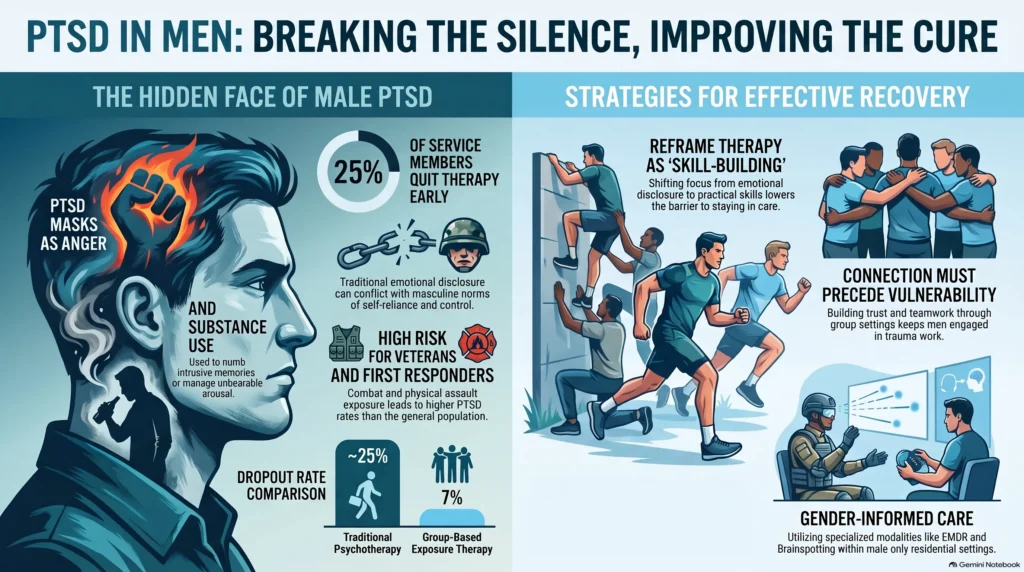
Yes. Anger and substance use are two of the most common ways PTSD surfaces in men, and both can function as a way to manage unbearable arousal or numb intrusive memories.
Treating the anger or the drinking without addressing the trauma underneath tends to produce only partial, temporary relief.
When Trauma Comes From Line of Duty
Men are more likely than women to experience trauma tied to combat, physical assault, and serious accidents, which puts veterans and first responders at particular risk [3]. PTSD affects roughly 7% of veterans at some point in their lives, a rate higher than the general adult population [5].
Getting a veteran or first responder into treatment is only part of the challenge. About a quarter of service members and veterans who start psychotherapy for PTSD quit before finishing it, though not every approach carries that risk equally [5].
Men whose identity is built on service, toughness, or being the one others rely on need connection before exposing vulnerabilities — not the other way around.
Group-based exposure therapy, which builds trust and teamwork before trauma work begins, keeps participants engaged far better than individual formats, with a dropout rate near 7% compared to much higher rates for some other first-line treatments [5].
Why Treatment Response Differs for Men
Trauma-focused psychotherapy, such as Cognitive Behavioral Therapy (CBT), Eye Movement Desensitization and Reprocessing (EMDR), and exposure-based approaches, is the recommended first-line treatment for PTSD [2].
Researchers suspect that differences in emotional expression and how men and women process fear play a role in treatment [3].
Framing therapy as skill-building rather than emotional disclosure, treating anger as a starting point rather than a problem to shut down, and using group settings where men hear other men describe the same struggle all lower the barrier to staying in care.
What Matters Most
- PTSD in men often shows up as anger, substance use, or withdrawal rather than fear and sadness.
- Masculine norms around self-reliance and emotional control delay diagnosis and drive men to leave therapy early.
- Men are less likely to seek trauma-focused treatment, which makes gender-informed care essential.
- Combat, physical assault, and first responder work raise men’s risk for PTSD in ways general treatment can overlook.
Gender-Specific Trauma Care for Men in San Diego County
There is no wrong time to ask for treatment that reflects how you actually experience trauma, not just how it is described in a textbook.
Wings Recovery offers a separate residential program for men, where a gender-specific setting makes it easier to open up.
At our center, men move through a full continuum of residential, partial hospitalization (PHP), and intensive outpatient (IOP) care.
Treatment integrates EMDR, Brainspotting, Internal Family Systems (IFS), Cognitive Behavioral Therapy (CBT), and Dialectical Behavior Therapy (DBT), as well as dedicated programming for first responders and military service members.
Trauma does not look the same in every man, and treatment should not either. To learn more about PTSD and trauma treatment for men at Wings Recovery, call (760) 377-9509.

Sources
[1] Camacho-Ruiz, J. A., et al. 2026. A Narrative Review of Men’s Mental Health: The Role of Stigma and Gender-Differentiated Socialization. Behavioral Sciences, 16(2), Article 262.
[2] National Institute of Mental Health. n.d. Post-Traumatic Stress Disorder. U.S. Department of Health and Human Services.
[3] Haering, S., et al. 2025. Sex and Gender Differences in Posttraumatic Stress Disorder: Current Evidence on Etiology, Trajectory and Treatment. Der Nervenarzt, 97(1), 34–41.
[4] Lonnen, E., and Paskell, R. 2024. Gender, Sex and Complex PTSD Clinical Presentation: A Systematic Review. European Journal of Psychotraumatology, 15(1), Article 2320994.
[5] American Psychological Association. 2025, Nov. 17. Not All PTSD Therapies Keep Veterans in Treatment, Study Warns.