














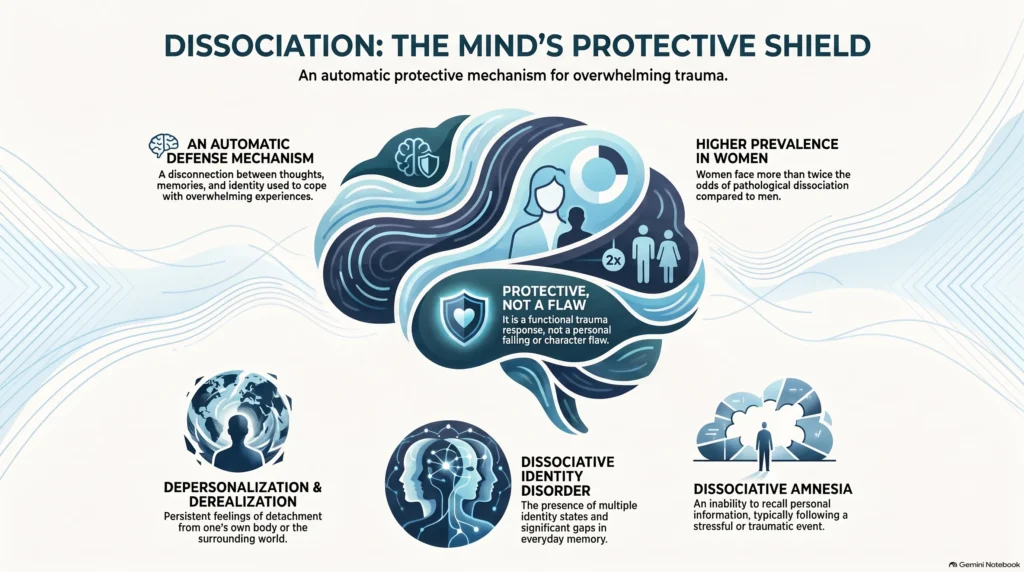
Dissociation is the mind’s way of separating from thoughts, memories, or a sense of self that feels too overwhelming to hold onto — a response to trauma or stress, not a personal failing. It can look like brief spacing out or, in severe cases, lost time or shifted identity.
A 2026 meta-analysis found women face more than twice the odds of pathological dissociation than men [1]. Naming it a trauma response, not a personality quirk, changes the treatment.
Dissociation Is a Protective Response, Not a Character Flaw
Dissociation is a disconnection between a person’s thoughts, memories, feelings, or sense of identity. Everyone has a mild version of it, such as daydreaming or losing an hour inside a book [2]. These are ordinary lapses in attention, not a disorder.
During a traumatic event, dissociation does something else entirely. It becomes an automatic protective response, pulling a person away from an experience too overwhelming to process while it is happening [3].
Someone may lose track of time, watch themselves from a distance, or find they cannot recall parts of what happened [2]. In the moment, that distance can help the person cope with the situation. The problem starts later, once the danger has passed and the distance has not.
What Does Dissociation Feel Like?
It may feel like watching your own life from outside your body or as if the world were going soft at the edges. Symptoms may also involve amnesia — a gap that is not ordinary forgetting: a person knows something is missing [2]. Some people describe absorption instead: a pull into thought so deep that the room around them disappears [3].
What Are the Different Types of Dissociative Disorders?
The Diagnostic and Statistical Manual of Mental Disorders (DSM-5-TR) groups dissociative disorders into three categories:
- Depersonalization/Derealization Disorder — persistent or recurring feelings of detachment from one’s own body and thoughts, from one’s surroundings, or both.
- Dissociative Identity Disorder — the presence of two or more distinct identity states, often along with gaps in memory for everyday events, personal information, or past trauma.
- Dissociative Amnesia — an inability to recall important personal information, usually tied to a traumatic or stressful event, that goes beyond ordinary forgetting. [2]
Each is a different pattern of disconnection. All three tend to start the same way, as a response to trauma (usually childhood trauma) that was overwhelming or repeated [2].
Is Depersonalization the Same as Derealization?
No, though the two are closely related. Depersonalization is detachment from your own body, thoughts, or actions. Derealization is detachment from the world around you, so that people, places, or objects feel unreal or dreamlike. Someone can experience either one, or both, and still be diagnosed with depersonalization/derealization disorder on its own — without having dissociative identity disorder or dissociative amnesia.
Is Dissociation the Same as Borderline Personality Disorder?
No, though the two are often confused. Dissociative symptoms, including amnesia and moments of depersonalization, show up in many people with Borderline Personality Disorder (BPD).
The reverse is just as true. For example, people with dissociative identity disorder are most often misdiagnosed with BPD first [4]. The overlap comes from shared surface features, such as identity disturbance and emotional instability.
Why Dissociation Is Often Missed or Misdiagnosed
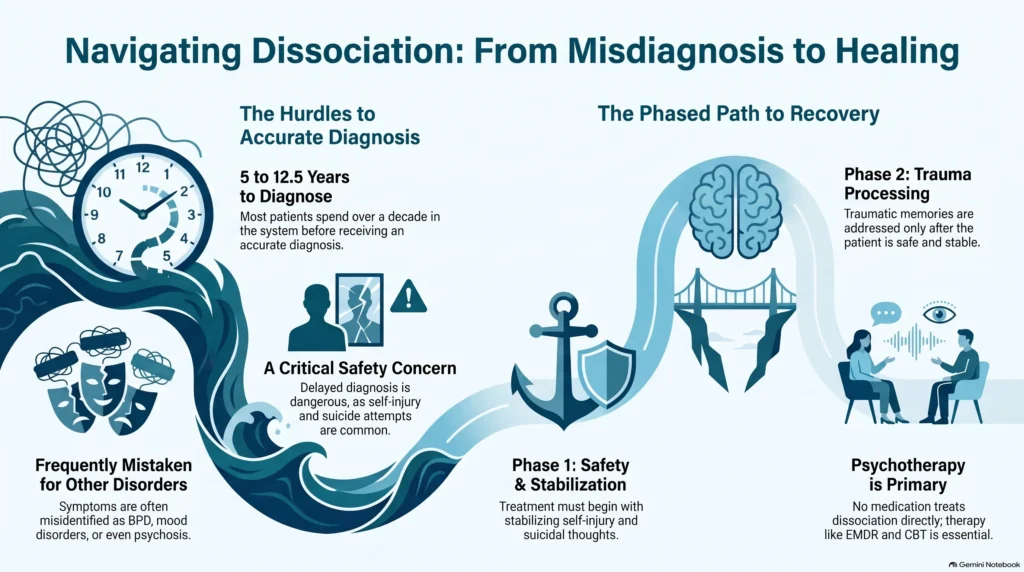
People with dissociative identity disorder often spend five to twelve and a half years in the mental health system before getting an accurate diagnosis [4]. Dissociative symptoms overlap with several other conditions, and many people minimize or simply do not recognize their own symptoms [2].
Some symptoms are mistaken for a personality disorder, a mood disorder, or psychosis, since an alternate identity state can be misread as a hallucination [4]. Self-injury and suicide attempts are also common among people with dissociative identity disorder, which turns the diagnostic delay into a safety problem [2].
A real evaluation takes more than one appointment, usually with input from family or other sources and tools built specifically to assess dissociation, not general-purpose screeners.
Treatment for Dissociation Starts With Safety, Not Confrontation
Effective treatment for dissociative disorders follows a phased approach:
- Phase one is safety and stabilization, because many people with dissociative disorders are also managing self-injury or suicidal thoughts.
- Phase two addresses traumatic memories directly [5].
Skip phase one, and phase two can do real damage.
Can Dissociation Be Treated Without Medication?
Yes. Psychotherapy is the primary treatment, and no medication treats dissociation itself directly [2][4]. Medication still has a role for the depression, anxiety, or sleep disruption that come along with dissociation.
It can be used together with therapies like Eye Movement Desensitization and Reprocessing (EMDR), Cognitive Behavioral Therapy (CBT), or Dialectical Behavior Therapy (DBT) rather than instead of them.
What Matters Most
- Dissociation runs from ordinary lapses in attention to disorders that disrupt memory, identity, and daily life.
- It usually starts as a protective response to trauma that was overwhelming, repeated, or both.
- It is frequently mistaken for Borderline Personality Disorder (BPD), a mix-up that can delay real treatment for years.
- Effective treatment follows an order: safety and stabilization first, then trauma processing, then integration.
Trauma-Focused Care for Dissociation in Carlsbad, California
At Wings Recovery, gender-specific residential, partial hospitalization (PHP), and intensive outpatient (IOP) programs are built around trauma-processing therapies such as EMDR, Brainspotting, and Internal Family Systems (IFS), alongside Cognitive Behavioral Therapy (CBT) and Dialectical Behavior Therapy (DBT).
Wings Recovery regularly takes on clients with dissociative symptoms, complex trauma, or co-occurring personality disorders, yet care here treats you or your loved one as more than a diagnosis.
You help shape your own treatment plan rather than simply following one, and the team’s support extends to nutrition and the other daily pieces of self-care that are easy to let slide.
There is no wrong time to start. Contact us today to learn more about Wings Recovery’s programs.

Sources
[1] Carraturo, F., et al. 2026. The Prevalence of Dissociative Disorders and Spirit Possession in the General Population: A Systematic Review and Meta-Analysis With the Moderating Effect of Individualism–Collectivism on Prevalence Rates. Clinical Psychological Science, 14(3), 270–295.
[2] American Psychiatric Association. 2024, Oct. What Are Dissociative Disorders?
[3] Esposito, R., et al. 2025. Exploring Differential Patterns of Dissociation: Severity and Dimensions Across Diverse Trauma Experiences and/or Attention-Deficit/Hyperactivity Disorder Symptoms. Behavioral Sciences, 15(7), Article 850.
[4] Mitra, P. and Jain, A. 2023. Dissociative Identity Disorder. StatPearls Publishing.
[5] Griffiths, T. A., et al. 2025. Effectiveness of Phase-Oriented Treatment for Trauma-Related Dissociative Disorders: A Systematic Review. European Journal of Psychotraumatology, 16(1), Article 2545734.