













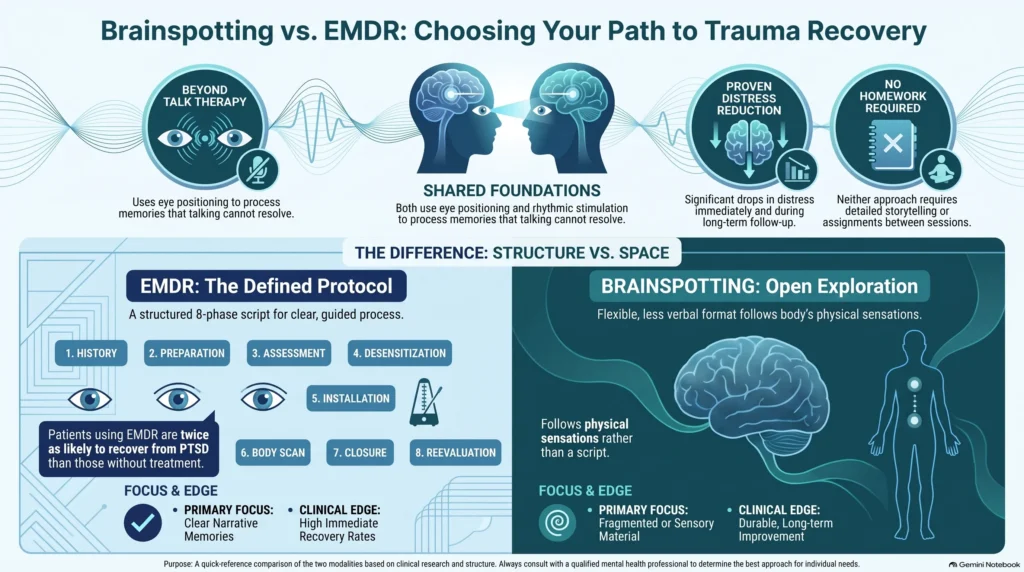
Brainspotting and EMDR are both evidence-based trauma therapies that use eye positioning to help the brain reprocess traumatic memories. They differ in structure: EMDR follows a defined protocol, while Brainspotting follows the client’s sense with no set script.
A 2026 study found that people who engaged in EMDR therapy were twice as likely to recover from PTSD as people who hadn’t started their treatment yet [1]. The fit depends on your nervous system’s response to structure versus open exploration.
How EMDR and Brainspotting Are Similar
Most therapy relies on talking through what happened. EMDR and Brainspotting work further downstream, using eye positioning and rhythmic stimulation (e.g. vibrations or tapping) to help the brain reprocess a memory that talking has not resolved.
A comparative study found that Brainspotting and EMDR both produced significant drops in a person’s distress about a difficult memory right after the session and at follow-up [2].
Brainspotting grew directly out of EMDR. Psychotherapist David Grand developed it in 2003 while working as an EMDR trainer, after noticing that certain fixed eye positions seemed to deepen a client’s access to stored trauma [2]. The two methods share a family resemblance, but the session experience is not the same.
What Is the Difference Between Brainspotting and EMDR?
The clearest difference is structure. EMDR works by having you hold a difficult memory in mind while following the therapist’s hand moving back and forth, which helps the brain settle the memory so it feels less raw over time.
EMDR follows a defined protocol with eight phases, from history-taking and target-memory assessment through the eye-movement work to a body scan for any remaining tension [3].
Brainspotting has no fixed number of phases. The therapist locates a fixed eye position, sometimes called a brainspot, tied to activation, and follows the client’s physical sensations from there rather than a script.
Neither approach requires talking through the traumatic event in detail, and neither assigns homework between sessions. The difference is how much structure guides the process once a session begins.
Structure or Space: What Works Better
Someone who dissociates easily may find Brainspotting’s quieter, less verbal format more suitable. Someone who wants a clear sense of where a session is headed and how far along they are may do better with EMDR’s structured protocol.
Research on Brainspotting is newer and smaller in scale than the decades of EMDR trials, but early findings are encouraging. A randomized controlled trial comparing Brainspotting with usual care found that usual care had an edge right after treatment, while Brainspotting showed more durable improvement at follow-up [4].
Can Brainspotting and EMDR Be Combined?
Yes. A clinician may use EMDR’s protocol for a memory that has a clear narrative and shift to Brainspotting for material that feels too fragmented to put into words.
Wings Recovery trains clinicians across a full range of trauma-processing approaches so a treatment plan can draw on more than one rather than forcing a single choice too early.
What a Session Feels Like
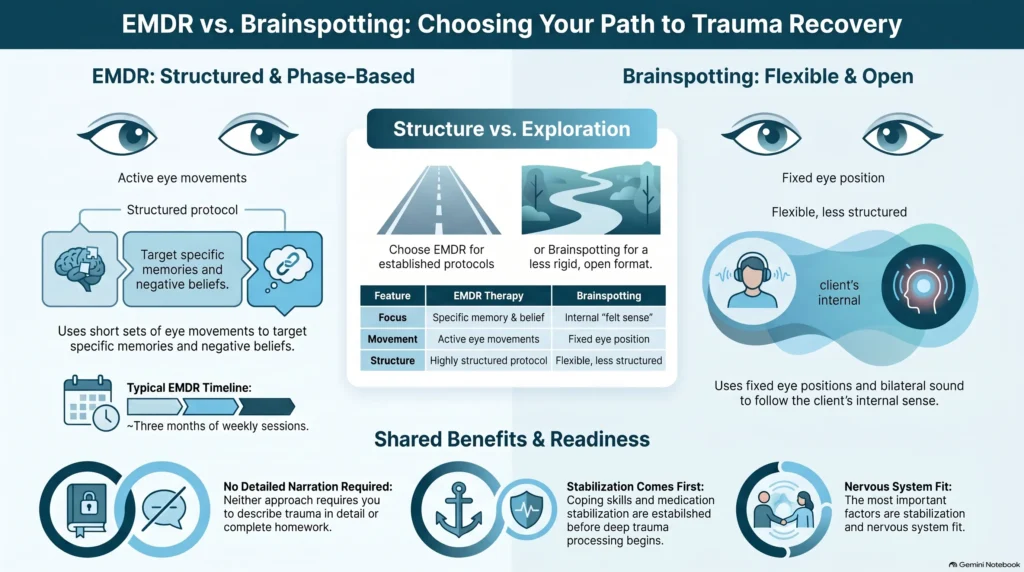
In EMDR, you and your therapist agree on a specific memory to target and the belief tied to it before the session gets underway. From there, you work through short sets of eye movements, pausing between each one to check in on what came up, until the memory stops carrying the same charge. The whole process typically runs about three months of weekly sessions [3].
Most clinical practice guidelines strongly recommend EMDR for treating PTSD, including the joint guideline from the Department of Veterans Affairs and the Department of Defense. The American Psychological Association gives it a conditional recommendation, ranking it among several therapies shown to be effective [3].
In Brainspotting, the therapist uses a pointer to find the eye position tied to activation, and the client rests their gaze there, often while listening to bilateral sound through headphones. There is no requirement to describe what comes up, and a session tends to feel less structured moment to moment.
How Do I Know Which Therapy to Start With?
At Wings Recovery, treatment often begins with EMDR, since it carries the more established research base of the two. If EMDR has felt ineffective for you before, that does not rule it out: in a safe, supportive environment with a highly trained therapist, it can still produce meaningful progress.
That said, some clients find EMDR’s structure too rigid and do better with Brainspotting’s more open format. A licensed clinician will assess your trauma history, how easily you dissociate, and your comfort with structure to help decide where to start, and it is normal to switch approaches if one does not fit the way you hoped.
Dissociation and Complex Trauma Can Complicate the Choice
Complex or repeated trauma can make either therapy feel too intense before someone is stabilized. Processing a memory before a person is ready may overwhelm them, while postponing it indefinitely leaves a major source of distress untouched.
At Wings Recovery, medication stabilization and coping-skill development happen before deep trauma work begins, whether a client’s plan eventually includes EMDR, Brainspotting, or both. Clients build the resources to tolerate processing rather than being rushed into it.
What Matters Most: EMDR vs Brainspotting at a Glance
- EMDR follows a structured, phase-based protocol; Brainspotting uses a fixed eye position and follows the client’s felt sense with no set script.
- Neither approach requires narrating trauma in detail or completing homework between sessions.
- Fit depends on a person’s nervous system, trauma history, and comfort with structure versus open exploration, not which approach is “better.”
- Stabilization and coping-skill development come first for clients with complex or dissociative trauma, regardless of which approach follows.
Gender-Specific Treatment for Trauma Recovery in San Diego County
At Wings Recovery in Carlsbad, separate programs for men and women let the clinical team get to know your trauma history, nervous system patterns, and goals without generalizations.
Wings Recovery trains clinicians in EMDR, Brainspotting, Internal Family Systems, Cognitive Behavioral Therapy (CBT), and Dialectical Behavior Therapy (DBT).
Depending on what you or your loved one needs, a treatment plan may combine trauma-processing approaches with holistic services such as acupuncture, equine therapy, and music therapy.
To learn more about Brainspotting or EMDR treatment at Wings Recovery, contact our admissions team today.

Sources
[1] Villegas-Ortega, J., et al. 2026. Effects of EMDR vs. Waiting List for Adults With Post-Traumatic Stress Disorder: A Systematic Review and Meta-Analysis of Randomized Controlled Trials. Journal of Affective Disorders, 392, 120134.
[2] D’Antoni, F., et al. 2022. Psychotherapeutic Techniques for Distressing Memories: A Comparative Study Between EMDR, Brainspotting, and Body Scan Meditation. International Journal of Environmental Research and Public Health, 19(3), 1142.
[3] Beauvais, D., et al. 2026. Eye Movement Desensitization and Reprocessing (EMDR) for PTSD. National Center for PTSD, U.S. Department of Veterans Affairs.
[4] Horton, L. M., et al. 2023-2024. Brainspotting: A Treatment for Posttraumatic Stress Disorder. International Body Psychotherapy Journal, 22(2), 57–72.