













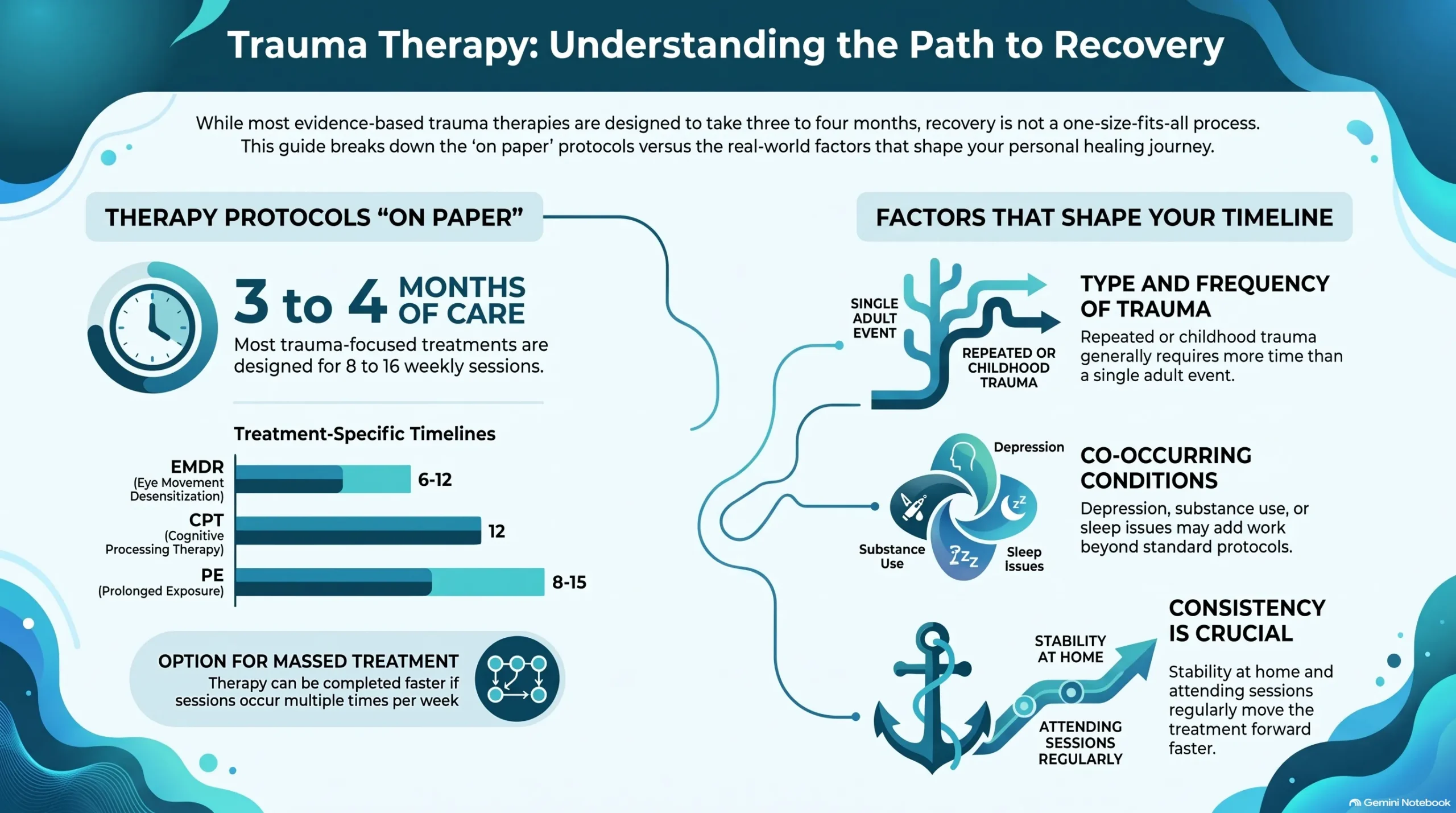
Most trauma-focused therapies are designed to run 8 to 16 weekly sessions, or roughly three to four months of care [1].
That range answers the question on paper. It does not tell you how long recovery will take for you or for your loved one, because trauma history, co-occurring conditions, sleep, and daily stability all shape the timeline.
What Research Says About Trauma Therapy Timelines
The most studied trauma treatments come with defined session counts. Cognitive Processing Therapy (CPT) is generally delivered over 12 sessions [2]. Prolonged Exposure (PE) is typically provided in weekly individual sessions over about three months, resulting in 8 to 15 sessions overall [3].
Eye Movement Desensitization and Reprocessing (EMDR) is usually delivered once or twice per week for a total of 6 to 12 sessions, and trauma-focused Cognitive Behavioral Therapy (CBT) generally runs 12 to 16 sessions [1].
The National Center for PTSD offers families a simpler figure: trauma-focused treatments generally take three to four months [4].
How Long Does Trauma Therapy Take on Average?
For a single traumatic event, three to four months of weekly sessions is a reasonable expectation. Prolonged or repeated trauma usually takes longer.
Those figures describe how the protocols were built and tested. They do not promise when symptoms will ease, because the protocol is only one part of the picture.
What Changes the Timeline
Several factors stretch or shorten trauma therapy. The number of traumatic events matters, and so does how long the exposure lasted.
Childhood and interpersonal trauma generally take longer to treat than a single adult event. Co-occurring depression, bipolar disorder, borderline personality disorder, dissociation, or substance use adds clinical work beyond a 12-session protocol.
Consistency matters as much as content. Missed weeks, ongoing crises, unsafe living situations, and untreated insomnia all slow down processing. Avoidance is also a symptom of PTSD, so the sessions a person most wants to skip are frequently the ones that move treatment forward.
Session count is a starting point rather than a rule. Several studies found that ending therapy based on a person’s progress produced better results than stopping at a set number of sessions [5].
Can Trauma Therapy Be Completed Faster?
Sometimes. “Massed treatment” delivers the same evidence-based therapy three times a week or more rather than once a week, and it appears to help more people complete a full course of care [6].
That pace is not right for everyone. It calls for clinical judgment about what a person can tolerate, and it works best when the rest of life is stable enough to allow that level of immersion.
Stabilization Comes First, and It Counts as Progress
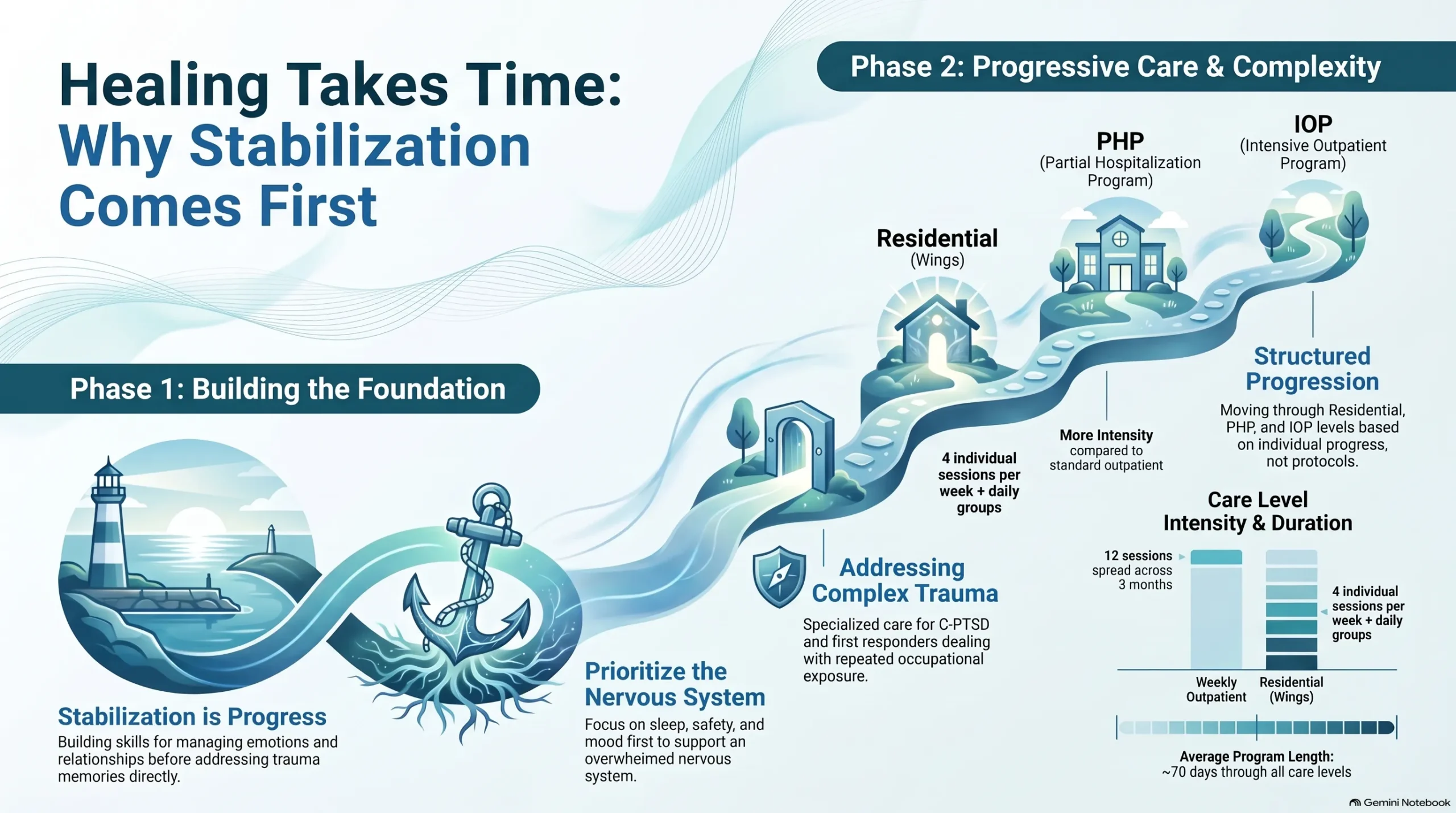
Some people are not ready to process trauma in the first week of treatment, and that is not a setback.
Phase-based treatment is most often reserved for complex cases, including Complex Post-Traumatic Stress Disorder (CPTSD), Borderline Personality Disorder (BPD), and prolonged interpersonal trauma, rather than single-incident PTSD, where CPT and EMDR are typically used on their own.
It begins by building skills for managing emotions and relationships before the trauma memory is addressed directly. Skills Training in Affective and Interpersonal Regulation (STAIR) is the most common example, though research has not yet established that it works better than trauma-focused treatment alone [4].
At Wings Recovery, medication stabilization and coping-skill development happen before deep trauma work, so clients are prepared for that stage rather than rushed into it. Sleep, safety, and mood come first, because trauma processing asks a great deal of a nervous system that is already overwhelmed.
Complex Trauma and Co-Occurring Conditions Extend the Work
Complex Post-Traumatic Stress Disorder (C-PTSD) follows prolonged or repeated trauma and brings added difficulty with emotional regulation, self-concept, and relationships.
Trauma-focused treatment remains the recommended place to start, and the same three-to-four-month range applies. Once primary PTSD symptoms such as flashbacks or nightmares improve, other concerns such as depression or relationship health may still need attention [4].
That pattern appears often in first responder mental health treatment. Repeated exposure to injury, death, and threat accumulates across a career, so treatment rarely centers on one memory. It usually addresses many, along with the hypervigilance that kept the person functioning on the job.
What Happens If Symptoms Do Not Improve?
A stalled course of therapy is information, not failure. The clinical team should revisit the diagnosis, review medication, examine sleep and substance use, and consider whether the frequency of sessions is sufficient. Some people need a different approach, and others need a higher level of care for a period of time.
How the Level of Care Changes the Math
Weekly outpatient therapy spreads 12 sessions across three months. Residential and Partial Hospitalization (PHP) programs compress far more clinical contact into the same calendar time. A person who has been stuck for years in weekly sessions may move quickly in a structured program.
At Wings Recovery, clients receive four individual therapy sessions per week at the residential level, alongside daily group work. Most clients spend close to 70 days moving through residential, PHP, and Intensive Outpatient Program (IOP) care.
What Matters Most
- Most trauma-focused therapies are designed for roughly 8 to 16 sessions across three to four months.
- Trauma history, co-occurring conditions, and daily stability all influence how long treatment takes.
- Stabilization work before trauma processing is part of treatment, not a delay in it.
- Progress, rather than a fixed session count, should determine when trauma therapy ends.
Gender-Specific Trauma Therapy in North San Diego County
Wings Recovery is a primary mental health and trauma program in Carlsbad, California, with separate programs for men and women. Gender-specific programming creates safer group dynamics and more honest conversations, which shortens the time it takes to reach the real material.
Care spans residential, PHP, and IOP levels. Depending on what you or your loved one needs, treatment may include psychiatric support, medication management, EMDR, Brainspotting, Internal Family Systems (IFS), CBT, Dialectical Behavior Therapy (DBT), individual and group therapy, and nutrition support.
A timeline should be built around the person, not around a protocol. To learn more about trauma therapy at Wings Recovery, call 888-790-9377.
Speak With Admissions
Sources
[1] American Psychological Association. n.d. Treatments for PTSD.
[2] American Psychological Association. n.d. Cognitive Processing Therapy (CPT).
[3] American Psychological Association. n.d. Prolonged Exposure (PE).
[4] National Center for PTSD. n.d. Complex PTSD. U.S. Department of Veterans Affairs.
[5] National Center for PTSD. n.d. Cognitive Processing Therapy for PTSD. U.S. Department of Veterans Affairs.
[6] VA News. 2024, May 29. Rapid Recovery – Massed Treatment for PTSD. U.S. Department of Veterans Affairs.