














Two people can make the same reckless purchase after an argument. One has slept three hours a night for six days and still feels energized. The other feels abandoned, spends impulsively, and then wakes ashamed the next morning.
The actions look similar, but what drives them is different. In Bipolar Disorder, impulsive behavior may appear during a broader manic episode marked by changes in sleep, energy, and activity.
In Borderline Personality Disorder (BPD), it may follow intense fear of rejection or abandonment and shift within hours. That distinction matters because the two conditions need different treatment plans. If you or your loved one receives the wrong diagnosis, the symptoms causing the most harm may remain untreated.
Similar Symptoms Can Hide Different Conditions
Both conditions can involve depression, anger, impulsivity, risky behavior, and unstable relationships.
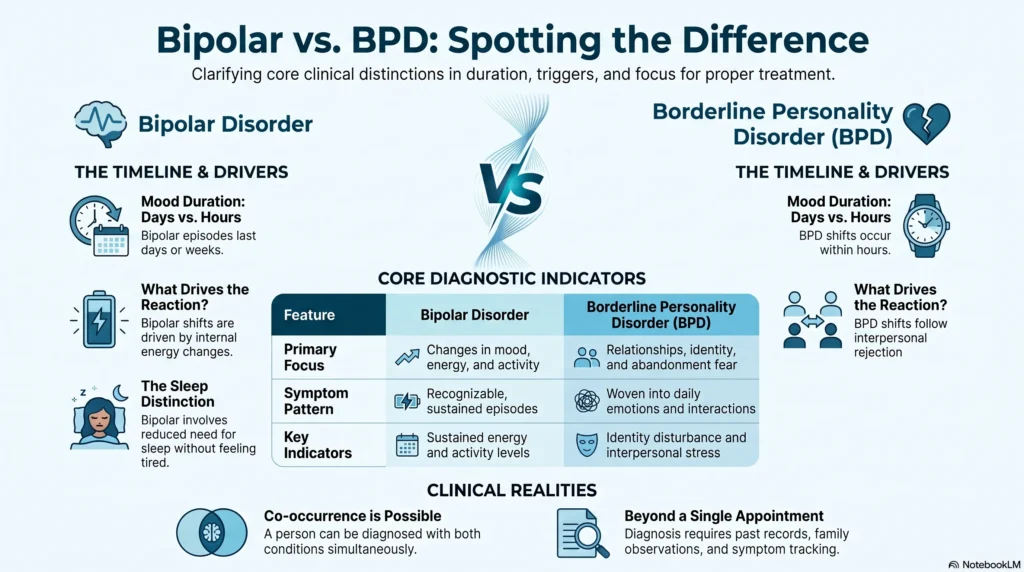
The National Institute of Mental Health describes bipolar disorder as causing “clear changes in mood, energy, and activity levels.” During mania or hypomania, someone may sleep very little without feeling tired, speak rapidly, feel unusually powerful or driven, and take risks far outside their usual behavior. These episodes generally last days or longer [1]. Often such manic episodes are followed by a deep depressive episode with loss of interest in activities previously found enjoyable.
BPD reaches beyond mood. It may affect how a person sees themselves, reads other people, and responds to rejection or separation. Emotional shifts can happen within hours, while fear of abandonment, identity disturbance, and unstable relationships form a broader pattern [2].
What Is the Clearest Difference Between Bipolar Disorder and BPD?
The clearest difference is the timeline. Bipolar disorder produces recognizable mood episodes, often with marked changes in sleep, energy, and activity. BPD symptoms are more closely woven into daily emotions and relationships.
Duration helps, but it doesn’t decide the diagnosis on its own. Mixed episodes, trauma, substance use, Attention-Deficit/Hyperactivity Disorder (ADHD), and severe sleep loss can blur the picture. A careful assessment may take more than one appointment because what happens between crises matters too.
The Timeline Often Reveals What a Symptom List Misses
Let’s return to the two people who spent recklessly. The first person’s elevated energy and reduced need for sleep continue after the argument has passed. The second person’s behavior rises directly from feeling rejected and shifts again by morning.
Reviews of the evidence find that sustained changes in energy, sleep, and mood episodes point more strongly toward bipolar disorder. Identity disturbance, unstable relationships, and reactions to interpersonal events indicate a higher probability of BPD [3].
Can Someone Have Bipolar Disorder and BPD at the Same Time?
Yes. When both conditions are present, treatment must address mood episodes alongside ongoing problems with emotional regulation, identity, impulsivity, or relationships.
A quick either-or answer can miss the mark. Clinicians usually need past records, family observations, medication response, and symptom tracking before the full picture becomes clear.
Why the Diagnosis Changes the Treatment Plan
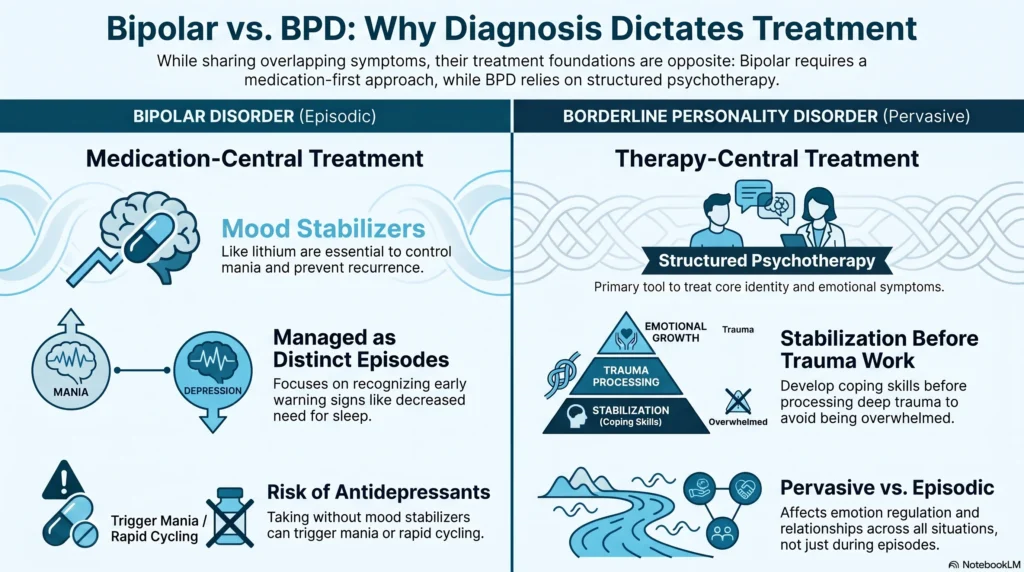
For bipolar disorder, medication is usually central. Mood stabilizers such as lithium or some atypical antipsychotics can treat episodes and reduce the chance of recurrence. Therapy helps people protect sleep, identify warning signs, repair relationships, and maintain routines, yet therapy alone may not control mania [1].
Antidepressants also require caution. In some people with bipolar disorder, taking an antidepressant without a mood stabilizer can trigger mania or rapid cycling.
BPD treatment starts with structured psychotherapy. The American Psychiatric Association recommends psychotherapy that targets the core symptoms and day-to-day functioning. Medication may address a specific symptom for a limited time, but it doesn’t treat the core pattern of BPD [4].
That changes what happens in treatment. Someone with BPD may need repeated practice in distress tolerance, emotional regulation, and boundaries. Someone with bipolar disorder may need to recognize that sleeping two hours a night and feeling unusually productive is an early warning sign, not recovery.
The risk of confusion isn’t theoretical. Research found that people with BPD were more likely to have been misdiagnosed with bipolar disorder [5].
How to Help Someone With Borderline Personality Disorder?
If you are willing to help a loved one with borderline personality disorder, take the distress seriously without accepting threats, abuse, or unsafe behavior. Listen without debating whether the feeling is reasonable.
Keep boundaries clear and predictable, and ask what has helped during previous crises. Encourage consistent professional care and take talk of suicide or self-harm seriously. Wings Recovery offers clinical guidance on how to support someone with BPD.
Trauma Can Complicate the Diagnosis
Trauma can disrupt sleep, trust, concentration, and emotional regulation. It may cause hypervigilance, dissociation, anger, or impulsive coping. Those symptoms can coexist with bipolar disorder, BPD, or both, but trauma history alone does not prove either diagnosis.
This matters in first responder mental health treatment. Repeated exposure to injury, death, and threat can produce symptoms that resemble several conditions. Assessment should reveal what changed after the trauma, what existed before, and whether there have been sustained episodes of altered energy and sleep.
People searching for trauma therapy may need trauma-focused treatment, psychiatric care, or an integrated plan. The order matters: processing trauma too early may overwhelm someone whose mood is unstable, while postponing it indefinitely can leave a major source of distress untouched.
People searching for trauma therapy may need trauma-focused treatment, psychiatric care, or an integrated plan. Stabilization comes first: medication management and the development of coping skills help a person tolerate the intensity of trauma processing before deep trauma work begins. This approach is the standard first step in Eye Movement Desensitization and Reprocessing (EMDR) as well.
Processing trauma before someone is stabilized may overwhelm them, while postponing it indefinitely can leave a major source of distress untouched.
At Wings Recovery, medication stabilization and coping-skill development happen before deep trauma work, so clients are prepared for that stage rather than rushed into it.
What Matters Most
- Bipolar disorder involves distinct episodes of mania, hypomania, and depression.
- BPD affects emotion regulation, identity, behavior, and relationships across situations.
- Medication is usually central to bipolar treatment; structured psychotherapy is the main treatment for BPD.
- The conditions can occur together, so one crisis or symptom checklist isn’t enough for diagnosis.
Gender-Specific Treatment for Bipolar Disorder and BPD in San Diego County
There’s no wrong time to ask for a clearer diagnosis or treatment that fits what is actually happening. At Wings Recovery, separate programs for men and women allow the clinical team to understand your history, symptoms, relationships, and goals without generalizations.
Wings treats adults with bipolar disorder, BPD, trauma, and co-occurring conditions through residential, partial hospitalization (PHP), and intensive outpatient care (IOP). Depending on what you or your loved one needs, treatment may include psychiatric support, medication management, Cognitive Behavioral Therapy (CBT), individual and group therapy, trauma-focused work, and nutrition support.
The diagnosis guides treatment, but it shouldn’t become the person’s identity. To learn more about bipolar disorder or BPD treatment at Wings Recovery, call (760) 377-9509.

Sources
[1] National Institute of Mental Health. n.d. Bipolar Disorder. U.S. Department of Health and Human Services.
[2] National Institute of Mental Health. n.d. Borderline Personality Disorder. U.S. Department of Health and Human Services.
[3] Sanches, M. 2019. The Limits Between Bipolar Disorder and Borderline Personality Disorder: A Review of the Evidence. Diseases, 7(3), 49.
[4] American Psychiatric Association. 2024. Practice Guideline for the Treatment of Patients With Borderline Personality Disorder.