













Residential mental health treatment becomes necessary when symptoms keep disrupting daily life, relationships, or safety despite consistent outpatient care.
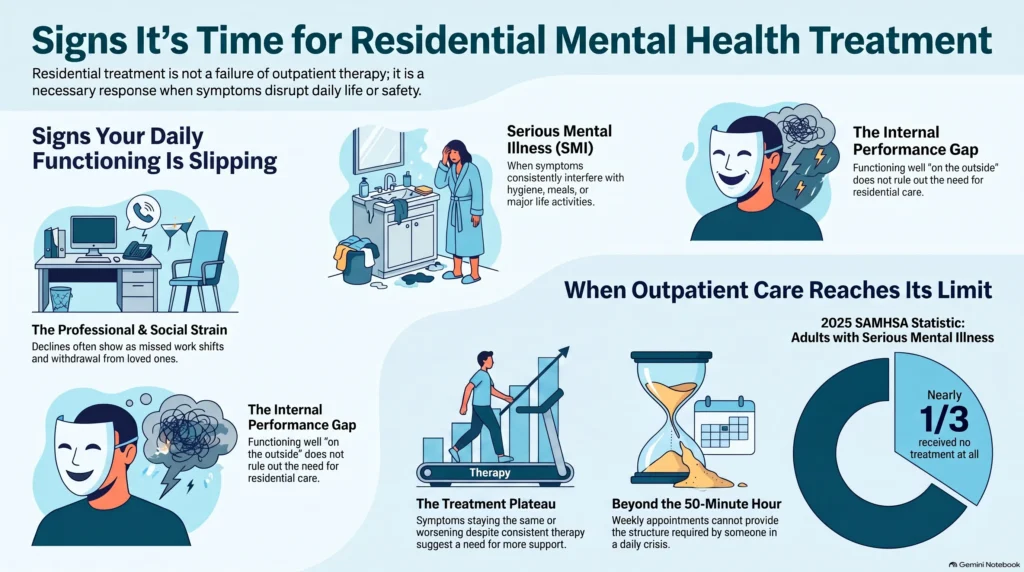
Nearly one-third of adults with a serious mental illness received no treatment at all in 2025, according to the Substance Abuse and Mental Health Services Administration (SAMHSA) [1].
The signs below help clarify when a higher level of care, not more willpower, is what someone actually needs.
When Does Outpatient Therapy Stop Being Enough?
Outpatient therapy works well for many people, but it assumes a level of stability between sessions. A weekly, fifty-minute appointment cannot provide the structure or support that someone in daily crisis needs.
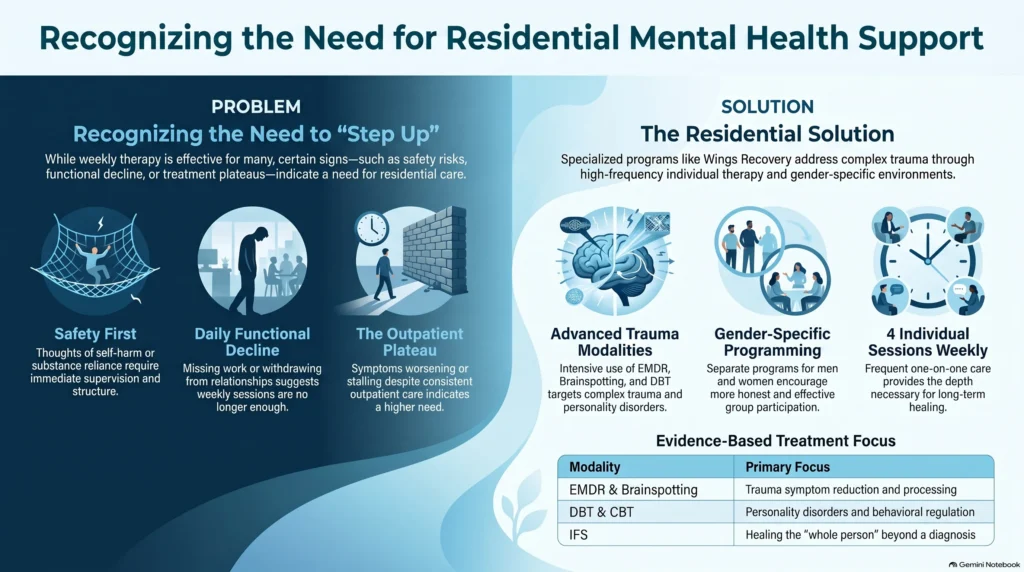
A plateau is one of the clearest signs that a change is needed. If symptoms have stayed the same or worsened despite consistent outpatient treatment, that pattern often points to a need for more support, not a different therapist.
Does Residential Treatment Mean Outpatient Therapy Failed?
No. Outpatient therapy is not less effective; it is matched to a different level of need. A higher level of care is a response to more severe symptoms, not a verdict on the treatment that came before.
Signs Your Daily Functioning Is Slipping
Work, relationships, and basic self-care often show strain well before someone recognizes how much their mental health has declined. Missed shifts, withdrawal from people who used to matter, or an inability to keep up with meals, sleep, or hygiene are all signs worth taking seriously.
When decline like this becomes sustained, it crosses into a specific clinical category — Serious Mental Illness (SMI). It refers to a diagnosable mental, behavioral, or emotional disorder that consistently interferes with a person’s ability to manage major life activities, according to the National Institute of Mental Health (NIMH) [2]. That interference is often what signals a need for a higher level of care.
What If I Can Still Go to Work but Everything Feels Harder?
Functioning on the outside does not rule out a need for residential treatment. Many people keep working or attending school while privately struggling to hold everything together, and that gap between appearance and internal experience needs to be addressed; if not, it only exacerbates.
Signs Your Mental Health Needs More Support
Safety concerns are the clearest indicator that residential treatment is necessary. Thoughts of self-harm or suicide, an unsafe home, or relying on substances to cope all point to the same thing: a need for closer supervision and structure.
Is Residential Treatment Only for People in Crisis?
No. Many people enter residential treatment before reaching a crisis point, specifically to prevent one. Safety concerns are one clear sign that a higher level of care is needed, but a gradual decline in functioning or a lack of progress in outpatient care can be just as strong an indicator.
Why Complex Trauma and Personality Disorders Often Need More Than Weekly Therapy
Complex trauma, dissociation, and personality disorders often respond to treatment differently than anxiety or depression.
While weekly therapy treats trauma’s core symptoms well, it is less effective for the identity and relationship difficulties that often follow prolonged or repeated trauma [3].
Treatment for trauma and personality disorders usually draws on more than one approach, including Eye Movement Desensitization and Reprocessing (EMDR) and Brainspotting, alongside Dialectical Behavior Therapy (DBT), which was originally developed for Borderline Personality Disorder (BPD) and remains one of the most established BPD treatments.
A 2025 randomized controlled trial found that EMDR produced outcomes comparable to Cognitive Behavioral Therapy (CBT) for BPD as well as meaningful reductions in trauma symptoms [4].
Gender-Specific Residential Care From Wings Recovery
Wings Recovery offers separate residential programs for men and women. Gender-specific programming supports more honest group participation and ensures that treatment reflects and heals trauma that surfaces differently across genders.
What Matters Most
- A plateau in outpatient therapy, symptoms worsening or not improving despite consistent care are the clearest signs a higher level of care is needed.
- Missed work, withdrawal from relationships, or an inability to keep up with daily routines point toward a level of disruption that weekly sessions cannot address.
- Thoughts of self-harm or suicide call for immediate support. The 988 Suicide and Crisis Lifeline is available 24/7.
- Complex trauma, dissociation, and personality disorders often need a phased, more intensive setting than standard outpatient therapy provides.
Residential Mental Health Treatment in San Diego County
Wings Recovery provides trauma-focused, gender-specific residential treatment for adults whose mental health is their primary concern.
Clients receive four individual therapy sessions each week at the residential level, along with EMDR, Brainspotting, Internal Family Systems (IFS), CBT, and DBT, depending on their treatment plan. Length of stay remains individualized throughout, since complex trauma and personality disorders rarely resolve on a fixed schedule.
Treatment at Wings Recovery looks at you or your loved one as a whole person, not just a diagnosis. You are an active participant in planning your own path, working alongside a team that also supports your nutrition and other pieces of daily self-care that often get overlooked.
Whenever you are ready is the right time to start. Call us anytime at 760-359-9950 to learn more about our programs.
Speak With an Admissions Specialist

Sources
[1] Substance Abuse and Mental Health Services Administration (SAMHSA). 2026, Jul. 27. Release of the 2025 National Survey on Drug Use and Health: Using Data to Drive the Great American Recovery. SAMHSA.
[2] National Institute of Mental Health (NIMH). 2024. Mental Illness. National Institute of Mental Health.
[3] Katalan, C. et al. 2026. Psychotherapy for Complex Post-Traumatic Stress Disorder: Efficacy and Therapeutic Factors. Frontiers in Psychology, 17, Article 1684921.
[4] Nvo-Fernandez, M. et al. 2025. Effectiveness of Eye Movement Desensitization and Reprocessing (EMDR) in Treating Borderline Personality Disorder: A Randomized Controlled Trial. Alpha Psychiatry, 26(2), Article 40031.