













Personality disorders often emerge as a response to trauma. Adults who experienced multiple adverse childhood experiences are most likely to develop a clinically significant personality disorder [1].
Therapies that only address symptoms are rarely successful if the underlying trauma is not processed. Trauma-focused care, not medication alone, is crucial in personality disorder treatment.
How Trauma Shapes the Development of Personality Disorders
A personality disorder is a lasting pattern of thinking, feeling, and relating to others that causes real distress or difficulty functioning. In a given year, an estimated 9.1% of U.S. adults meet the criteria for a personality disorder, and most also live with another mental health condition [2].
These patterns rarely appear out of nowhere. Borderline Personality Disorder (BPD), the most researched personality disorder, is marked by ongoing instability in mood, self-image, and relationships, often producing impulsive behavior and intense fear of abandonment [3]. Similar instability shows up, in different forms, across several other personality disorders.
What connects many of these presentations is trauma. Early experiences of abuse, neglect, or chronic invalidation can shape how a child learns to see themselves, trust others, and manage overwhelming emotions. These are patterns that can carry into adulthood as a diagnosable personality disorder.
What Is the Connection Between Trauma and Personality Disorders?
One of the strongest known risk factors for a personality disorder is trauma, especially early and repeated trauma within close relationships, which shapes the coping strategies, self-image, and relational expectations that clinicians later recognize as disorder symptoms.
That does not mean every personality disorder traces back to identifiable trauma, but for many people, the diagnosis reflects a survival response more than a fixed trait. The pathway tends to look different depending on the disorder.
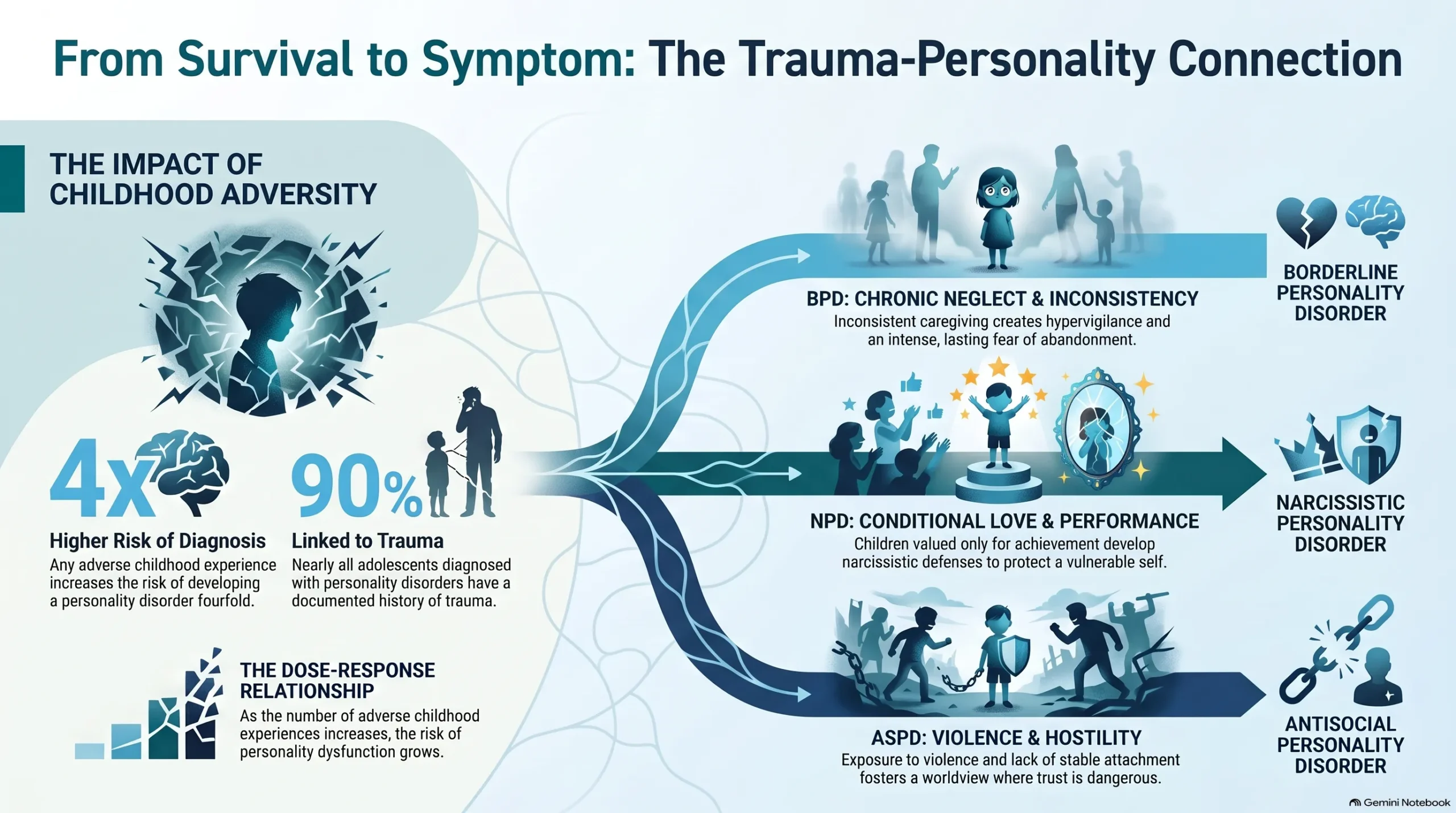
Borderline Personality Disorder (BPD): One of the most well-documented pathways to BPD is chronic childhood trauma, particularly emotional neglect or inconsistent caregiving. When a child cannot predict whether a caregiver will be safe or present, hypervigilance around relationships, an intense fear of abandonment, and an unstable self-image often take root — patterns that can persist well into adulthood.
Narcissistic Personality Disorder (NPD): Here, trauma more often looks like conditional love than outright neglect. Children who were valued mainly for performance, appearance, or achievement, or who were pushed into an adult caregiving role too early, may develop narcissistic defenses to protect a sense of self that never felt safe enough to be seen as it was [7].
Antisocial Personality Disorder (ASPD): Being exposed to violence, abuse, or chronic instability early in life, especially without one stable attachment figure, makes the development of ASPD more likely. When a child’s environment repeatedly teaches them that the world is hostile and that trust is dangerous, there is less of a foundation for empathy and rule-following to develop [8].
These are patterns seen across research and clinical practice, not guarantees. Genetics, temperament, and other life experiences may also define whether trauma results in a personality disorder at all, and if it does, which disorder develops.
The Research Behind the Trauma-Personality Disorder Link
A 14-year longitudinal study that followed more than 8,000 adolescents found that any adverse childhood experience raised the risk of a later personality disorder diagnosis by nearly fourfold. Emotional abuse was one of the strongest predictors, and roughly 90% of the adolescents who developed a personality disorder had a documented history of adverse childhood experiences [4].
More recent research found a dose-response relationship: the more adverse childhood experiences a person accumulates, the greater their risk of clinically significant personality dysfunction [1].
These results do not prove that trauma alone causes personality disorders. Temperament, genetics, and other developmental factors also play a role. In any scenario, thorough personality disorder assessment should include a trauma history, not just a symptom checklist.
Why Trauma-Focused Treatment Changes the Outcome
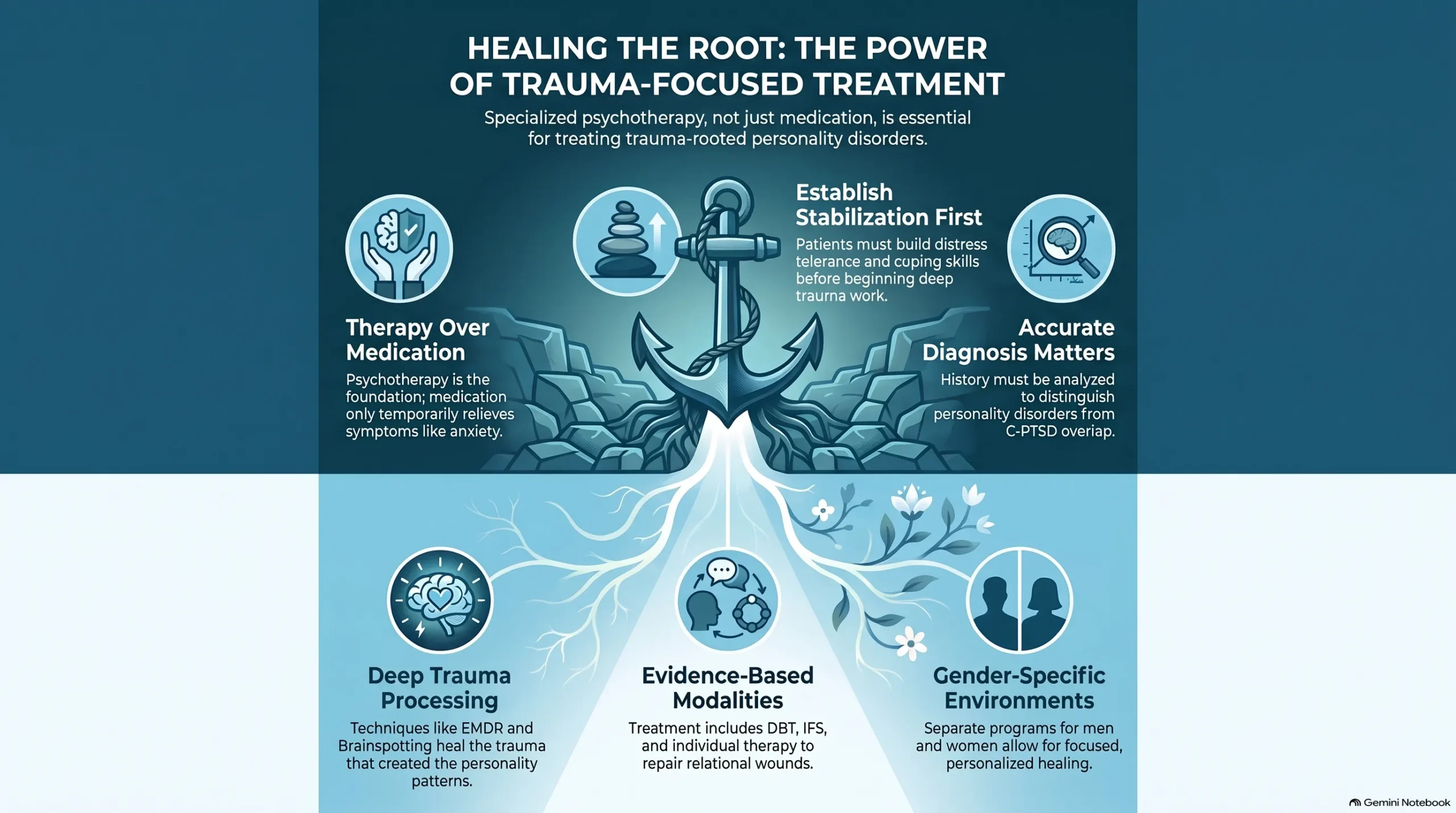
For most personality disorders, structured psychotherapy, not medication, is the foundation of treatment. The American Psychiatric Association (APA) recommends psychotherapy that targets core symptoms and day-to-day functioning as the primary approach [5].
Techniques such as Dialectical Behavior Therapy (DBT), Eye Movement Desensitization and Reprocessing (EMDR), Internal Family Systems (IFS) and Brainspotting are capable of healing both the personality patterns and the trauma that created them. While medication can temporarily relieve a specific symptom such as anxiety or mood instability, it doesn’t fix the core pattern.
Someone with a trauma-rooted personality disorder may need repeated practice in distress tolerance and emotional regulation, alongside direct processing of the memories or relational wounds driving those patterns.
How to Help Someone With a Personality Disorder Rooted in Trauma?
If you are supporting a loved one, take their distress seriously without accepting abuse or unsafe behavior. Listen without debating whether the feeling is reasonable and keep boundaries clear and predictable.
Encourage consistent professional care, and take any talk of suicide or self-harm seriously. Wings Recovery offers clinical guidance on how to support someone through this process.
Trauma Can Blur the Line Between Diagnoses
Complex Post-Traumatic Stress Disorder (C-PTSD) and personality disorders such as BPD share several features, including emotion dysregulation and relational difficulty, which can make them hard to tell apart. Research shows the two remain distinct, though frequently co-occurring, syndromes rather than variations of the same condition [6].
The overlap matters most in cases of sustained or repeated trauma exposure. This includes survivors of prolonged interpersonal abuse, first responders, and military service members. Their symptoms may resemble a personality disorder while reflecting an unresolved trauma response that calls for different treatment.
Effective trauma-focused care builds stabilization and coping skills before deeper trauma processing (e.g., EMDR or Brainspotting) begins. This way, the nervous system has the capacity to tolerate therapy without becoming overwhelmed.
At Wings Recovery, clients establish this foundation through frequent individual therapy sessions and medication management when appropriate before moving into deeper trauma processing.
What Matters Most
- Personality disorders often develop as adaptations to trauma, abuse, neglect, or chronic invalidation, not as fixed character flaws.
- The greater the number of adverse childhood experiences, the greater the risk of a clinically significant personality disorder.
- Trauma-focused psychotherapy, not medication, is usually the foundation of effective personality disorder treatment.
- Personality disorders and trauma-related conditions such as C-PTSD can overlap, so an accurate diagnosis requires looking at trauma history, not just a symptom checklist.
Gender-Specific Treatment for Personality Disorders and Trauma in Carlsbad, CA
At Wings Recovery, separate residential programs for men and women allow the clinical team to focus on your history, relationships, and goals without generalizations.
Wings Recovery treats adults with personality disorders, complex trauma, PTSD, and co-occurring conditions through a full continuum of residential, partial hospitalization (PHP), and intensive outpatient (IOP) care, with an average length of stay of approximately 70 days.
Depending on what you or your loved one needs, treatment may include psychiatric support, medication management when appropriate, Dialectical Behavior Therapy (DBT), Cognitive Behavioral Therapy (CBT), Eye Movement Desensitization and Reprocessing (EMDR), Internal Family Systems (IFS), Brainspotting, and individual and group therapy.
Contact our admissions team to learn more about personality disorder or trauma treatment at Wings Recovery.

Reach Out for Help Today
Sources
[1] Martin, R. C., et al. 2026. Examining the Relationship Between Adverse Childhood Experiences and ICD-11 Personality Disorder in a Community Mental Health Sample. Personality and Mental Health, 20(1), e70063.
[2] National Institute of Mental Health. n.d. Personality Disorders. U.S. Department of Health and Human Services.
[3] National Institute of Mental Health. n.d. Borderline Personality Disorder. U.S. Department of Health and Human Services.
[4] Broekhof, R., et al. 2024. Adverse Childhood Experiences Are Associated With Personality Disorder: A Prospective, Longitudinal Study. Journal of Personality Disorders, 38(1), 19–33.
[5] American Psychiatric Association. 2024. Practice Guideline for the Treatment of Patients With Borderline Personality Disorder.
[6] Ford, J. D., and Courtois, C. A. 2021. Complex PTSD and Borderline Personality Disorder. Borderline Personality Disorder and Emotion Dysregulation, 8, Article 16.
[7] dos Reis, A., et al. 2025. The Role of Parenting Styles in Narcissism Development: A Systematic Review and Meta-Analysis. AppliedMath, 5(1), Article 23.
[8] Aceto, M., et al. 2026. Roles of Adverse Childhood Experiences and Early Maladaptive Schemas in Antisocial Personality Disorder: A Systematic Review. Clinical Neuropsychiatry, 23(1), 30–48.