














Internal Family Systems (IFS) therapy treats trauma by helping a person recognize the different “parts” that trauma leaves behind, then build a working relationship with each one instead of trying to silence it.
A person who feels composed at work but shuts down during conflict at home is not being inconsistent. Different parts step forward to manage different situations, often based on patterns formed long before the person had any say in them.
When you attack a part, the behavior it drives, such as withdrawal, outbursts, or numbing, tends to persist. IFS works by changing that relationship from the inside.
How IFS Understands the Parts Trauma Creates
The National Institute of Mental Health describes trauma responses as involving shifts in mood, arousal, and behavior that can persist long after a dangerous event has passed, including avoidance, hypervigilance, and emotional numbing [1].
IFS approaches these shifts differently. Rather than treating them as symptoms to eliminate, IFS treats them as parts of the person, each one formed to manage pain or danger.
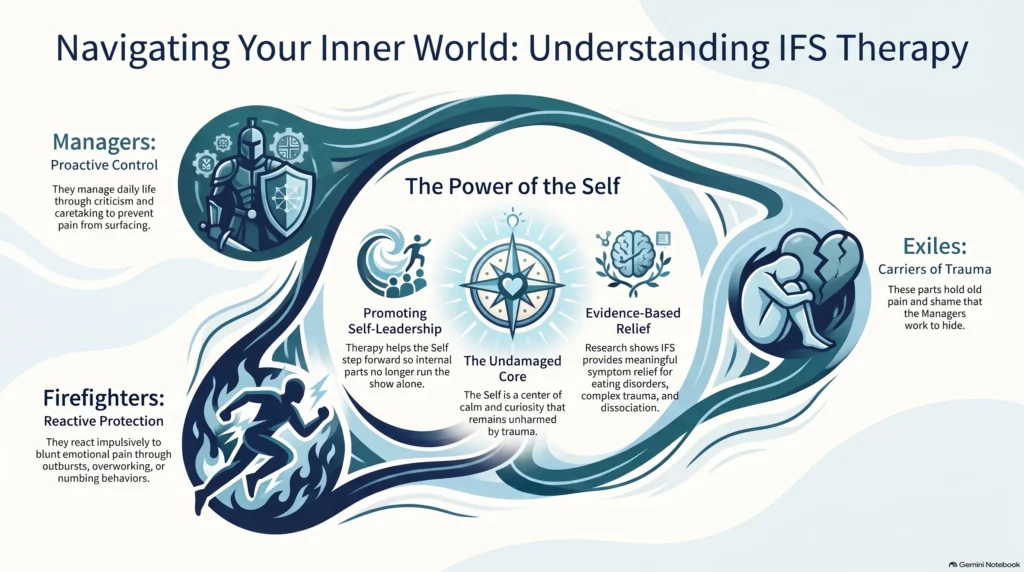
IFS describes three general categories of parts:
- Managers try to keep daily life under control, often through criticism and caretaking.
- Firefighters react quickly when pain surfaces, often through impulsive behavior such as substance use, overworking, or self-harm, to blunt the feeling as fast as possible.
- Exiles carry old pain and are the parts Managers work hardest to keep out [2].
What Is the Role of the Self in IFS Therapy?
IFS holds that beneath these parts sits the Self, a core of calm, curiosity, and clarity that is not damaged by trauma, even when it is difficult to access. Treatment does not try to erase Managers, Firefighters, or Exiles. It works to help the Self step forward so parts no longer have to run the show alone [2].
Why Trauma Responses Make More Sense Through an IFS Lens
Imagine a person who is composed at work but shuts down at home. A Manager part may be holding that composure together during the day, using control and performance to stay safe.
At home, where the stakes feel personal, an Exile carrying old fear or shame may surface, and a Firefighter may step in fast, through withdrawal, anger, or shutting down completely.
Seen this way, the shutdown is not a character flaw or a failure of willpower. It is a protective sequence that made sense at some point, even if it no longer fits the present moment.
Can IFS Therapy Help With Complex Trauma or Dissociation?
Yes, and current research supports it. IFS was originally developed to treat eating disorders, and its use has since expanded into trauma-focused work, including complex trauma and dissociative symptoms [3].
The evidence base is still smaller than that of longer-established trauma therapies such as Dialectical Behavior Therapy (DBT), but a growing number of studies point toward meaningful symptom relief.
How Effective Is IFS Therapy for Trauma?
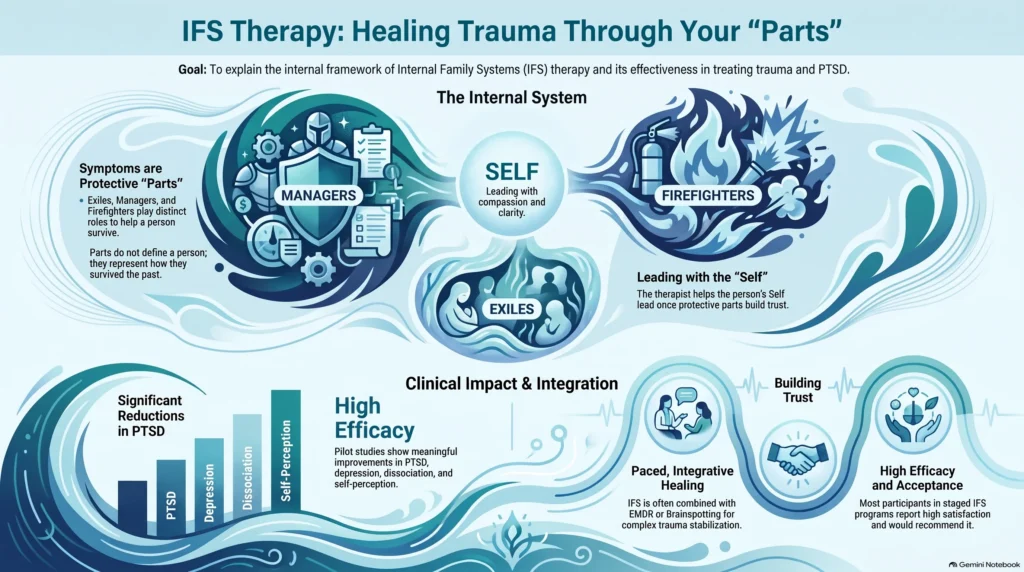
Early research on IFS for trauma has shown encouraging results. In a pilot study of adults with PTSD and histories of multiple childhood trauma, participants who completed a course of IFS sessions showed significant reductions in PTSD symptoms, along with improvements in depression, dissociation, and self-perception [4].
A separate pilot program combining group and individual IFS sessions for adults managing both PTSD and substance use found high rates of efficacy, with most participants completing the program and reporting they would recommend it to others [5].
These are early-stage studies rather than large controlled trials, so the findings point toward promise more than proof. Larger studies are still needed before IFS can be considered a first-line treatment for trauma in the way exposure-based therapies currently are [1].
What Happens in an IFS Therapy Session?
A typical IFS session starts by identifying a part left behind by trauma that is active, often one connected to a current struggle, such as anxiety, anger, or avoidance.
The therapist helps the person approach that part with curiosity rather than judgment, and, once trust is built, asks it to step back so the person’s Self can lead.
Managers often need reassurance before they will allow an Exile to be approached, and it is only once that permission is given that old pain can begin to heal [2].
When IFS Therapy Is Combined With Other Trauma-Focused Approaches
IFS rarely stands alone in trauma treatment. Clinicians frequently combine it with other trauma-focused approaches, such as Eye Movement Desensitization and Reprocessing (EMDR) or Brainspotting, using IFS to build a relationship with a part before deeper processing begins.
This sequencing matters most for complex trauma and dissociation. A proof-of-concept study of a 16-week, group-based IFS program for PTSD, delivered alongside individual sessions, found the structured, staged format to be feasible and well accepted by participants, supporting this kind of paced approach for trauma-focused group care [6].
This need for stabilization also comes up in first responder and military mental health treatment, where repeated exposure to danger and loss can produce protective parts that formed for good reason. Assessment should look at what a part is protecting against before treatment asks that part to stand down.
What Matters Most
- IFS treats trauma symptoms as protective “parts” rather than problems to eliminate.
- Exiles, Managers, and Firefighters each play a distinct protective role, and the Self remains the intended source of internal leadership.
- Early research shows meaningful symptom improvement, though the evidence base is still smaller than that of CBT or EMDR.
- IFS often works best alongside other trauma-focused approaches, especially for complex trauma or dissociation.
Gender-Specific IFS Therapy and Trauma Treatment in San Diego County
There is no wrong time to ask whether a different approach to trauma treatment could help. At Wings Recovery in Carlsbad, California, men and women-specific programs ensure that individuals have a safe space to address trauma, with a clinical team that understands the unique challenges each gender faces.
Wings Recovery treats adults with PTSD, complex trauma, and co-occurring mental health conditions through residential, partial hospitalization (PHP), and intensive outpatient (IOP) levels of care.
Clinicians integrate IFS alongside EMDR, Brainspotting, and other trauma-focused approaches, with psychiatric support and medication management available for clients who need it.
The “parts” do not need to define a person now; they are how that person survived in the past.
To learn more about IFS therapy and trauma treatment at Wings Recovery, call (760) 377-9509 today.
Talk With Admissions

Sources
[1] National Institute of Mental Health. n.d. Post-Traumatic Stress Disorder. U.S. Department of Health and Human Services.
[2] Schwartz, R. C. n.d. Evolution of the Internal Family Systems Model. IFS Institute.
[3] Buys, M. E. 2025. Exploring the Evidence for Internal Family Systems Therapy: A Scoping Review of Current Research, Gaps, and Future Directions. Clinical Psychologist, 29(3), 241–260.
[4] Hodgdon, H. B., et al. 2022. Internal Family Systems (IFS) Therapy for Posttraumatic Stress Disorder (PTSD) Among Survivors of Multiple Childhood Trauma: A Pilot Effectiveness Study. Journal of Aggression, Maltreatment & Trauma, 31(1), 22–43.
[5] Ally, D., et al. 2025. A Pilot Study of an Online Group-Based Internal Family Systems Intervention for Comorbid Posttraumatic Stress Disorder and Substance Use. Frontiers in Psychiatry, 16, Article 1544435.
[6] Comeau, A., et al. 2024. Online Group-Based Internal Family Systems Treatment for Posttraumatic Stress Disorder: Feasibility and Acceptability of the Program for Alleviating and Resolving Trauma and Stress. Psychological Trauma: Theory, Research, Practice, and Policy, 16(Suppl 3), S636–S640.